


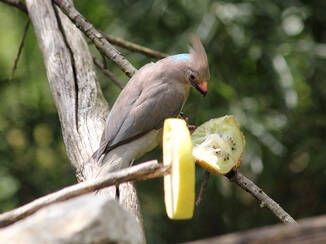





African lion in the Tierwelt Herberstein
Lion
Panthera leo
A lion rarely comes alone
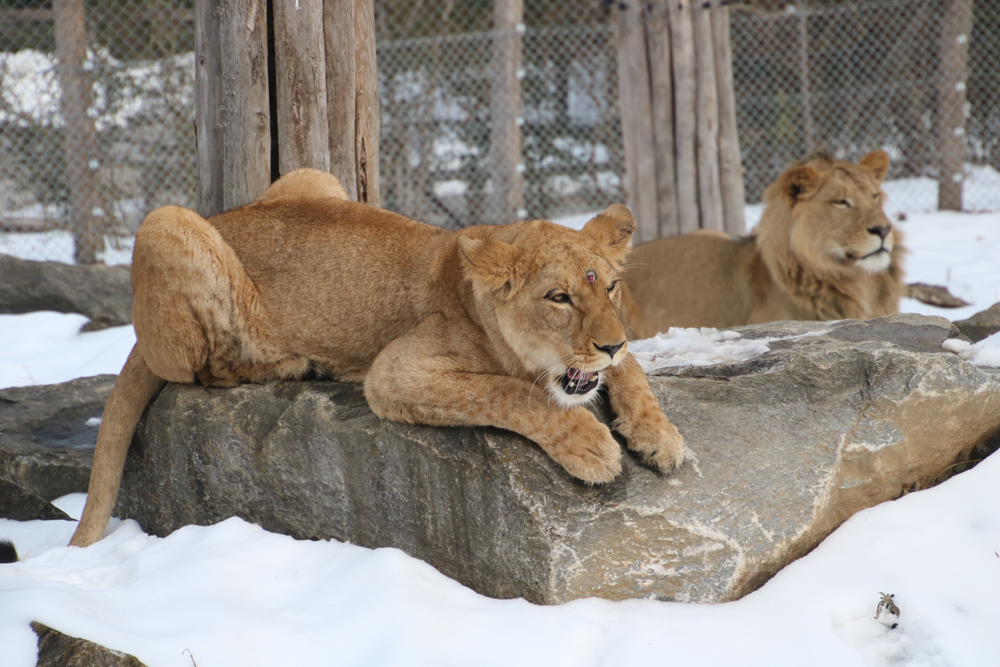
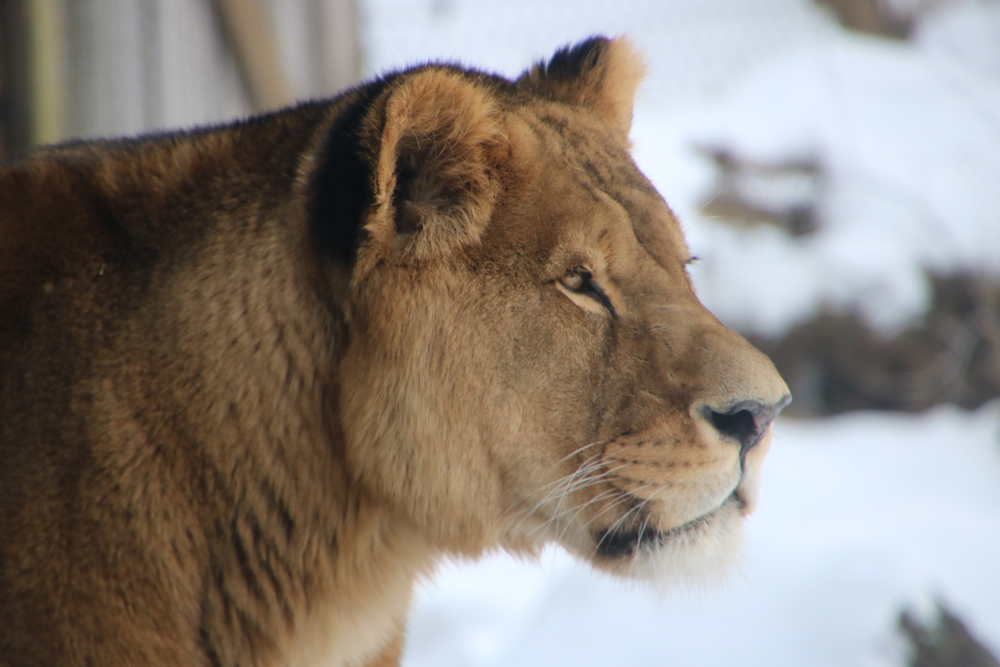
Lions are the only cats that live in social groups year-round. A pride usually consists of one to three males—who are typically related—up to ten females, and their offspring.
The social life of African lions offers several advantages, such as cooperation and the division of labor during hunting, territory defense, and raising cubs. When there’s nothing to do, they doze—up to 18 hours a day.
The lions' original range extended across all of Africa to Southwest Asia. The last lions in Europe (Greece) became extinct 2,000 years ago.
Today, the species is found exclusively in sub-Saharan Africa. The Asian subspecies is now found only in India's Gir National Park and in two small populations outside of it.
Did you know?
A male lion's roar can be heard up to 8 km away by the human ear. It has a calming effect on the female members of the pride and marks the boundaries of the territory.

| Order | Predators |
| Family | Cats |
| Distribution | Africa: sub-Saharan Africa; Asia: Northwest India |
| Habitat |   |
| Food |  |
| Activity |   |
| Weight | M 150–250 kg, W 120–185 kg |
| Size | Body length 140–250 cm, shoulder height 80–110 cm |
| Service life | Males: 7–12 years, females: 14–20 years (zoos: up to 25 years). While a male lion in the wild has a life expectancy of no more than 12 years, he can live to about twice that age in a zoo. |
| Reproduction | After a gestation period of 3.5 months, the female leaves the pack to give birth. Typically, between 2 and 4 cubs are born, and they are returned to the pack when they are 6–8 weeks old. |
| Risk |  |
| Enemies | Human |
Barbary Lions
Our lions belong to the subspecies known as the Barbary lion. This is one of the subspecies that is now extinct in the wild.
As early as the time of the Roman Empire, these animals were heavily hunted: they were needed for gladiator fights and other “entertainment” in the arenas. The “consumption” of these animals was very high, and it is now believed that this form of entertainment contributed significantly to the extinction of several other animal species even back then. The Barbary lions were able to recover from these losses once more, but with the invention of firearms, the rate at which the animals were dying off increased rapidly. The last lion in the wild was killed in Morocco around 1920 (though some sources report that the animals in inaccessible areas were not exterminated until 20–30 years later).
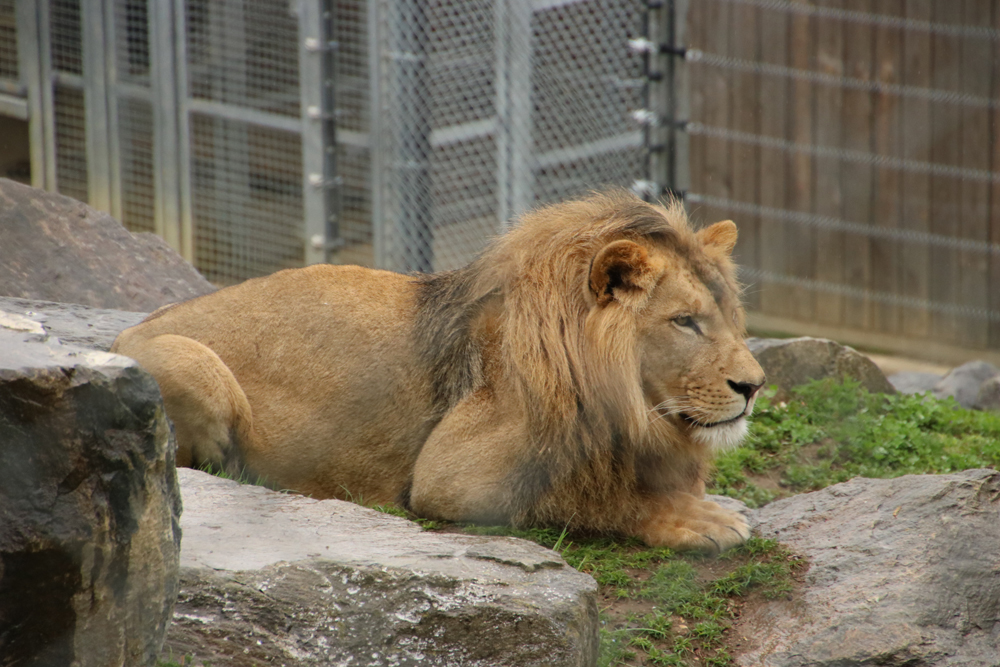
Berber lions differ from other lion subspecies in several characteristics: They are larger (shoulder height over 110 cm), heavier (males weighing up to nearly 300 kg), and have a more imposing, dark mane that extends over the chest and belly. They were originally found throughout North Africa, but later only in the Atlas Mountains (Morocco and Algeria). The reason for the more robust mane may be that it is colder in the Atlas Mountains, and the animals were thus better protected from the cold temperatures.
As the animals became increasingly rare in the wild, Berber tribes gifted some of them to Moroccan princes. In 1970, the Rabat Zoo received Berber lions from Hassan II’s private zoo, which were presumably direct descendants of these animals. However, it remains unclear to this day how many of the animals remained purebred; most were likely crossed with other subspecies. In the years that followed, these animals were distributed among various zoos—mostly in Europe—to broaden the breeding base and ensure the animals’ survival, at least within zoos.
for more information on species conservation
More information about young talent
Corporate Sponsorships
, Attorney at Law Ms. MAG. DR. HEIKE BERNER
8330 Feldbach, Bürgergasse 22/2
www.ra-berner.at
03152 / 67 40 10




Tierwelt Herberstein
Steirischer Landestiergarten GmbH
A 8223 Stubenberg am See
Buchberg 50
Phone: +43 3176 80777
Fax: +43 3176 80777 20
Email: info (at) tierwelt-herberstein. at