







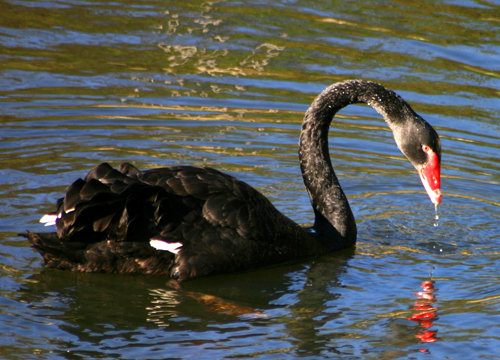
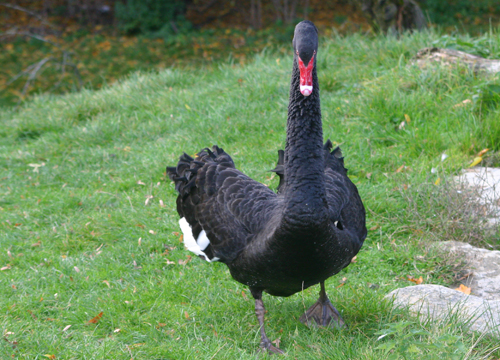
Mourning Swan
Black Swan
Cygnus atratus
No Sign of Grief
Young mourning swans live in groups to find a suitable mate. Once a pair has found each other, they go through life together from then on. To demonstrate their bond and defend the territory they once fought so hard to claim, the pair holds regular “triumph ceremonies” according to strict rules. The male initiates the ceremony by swimming toward the female with his chin raised, wings spread, and calling out loudly. After taking turns nodding their heads and stretching their necks, they then swim harmoniously in a circle.
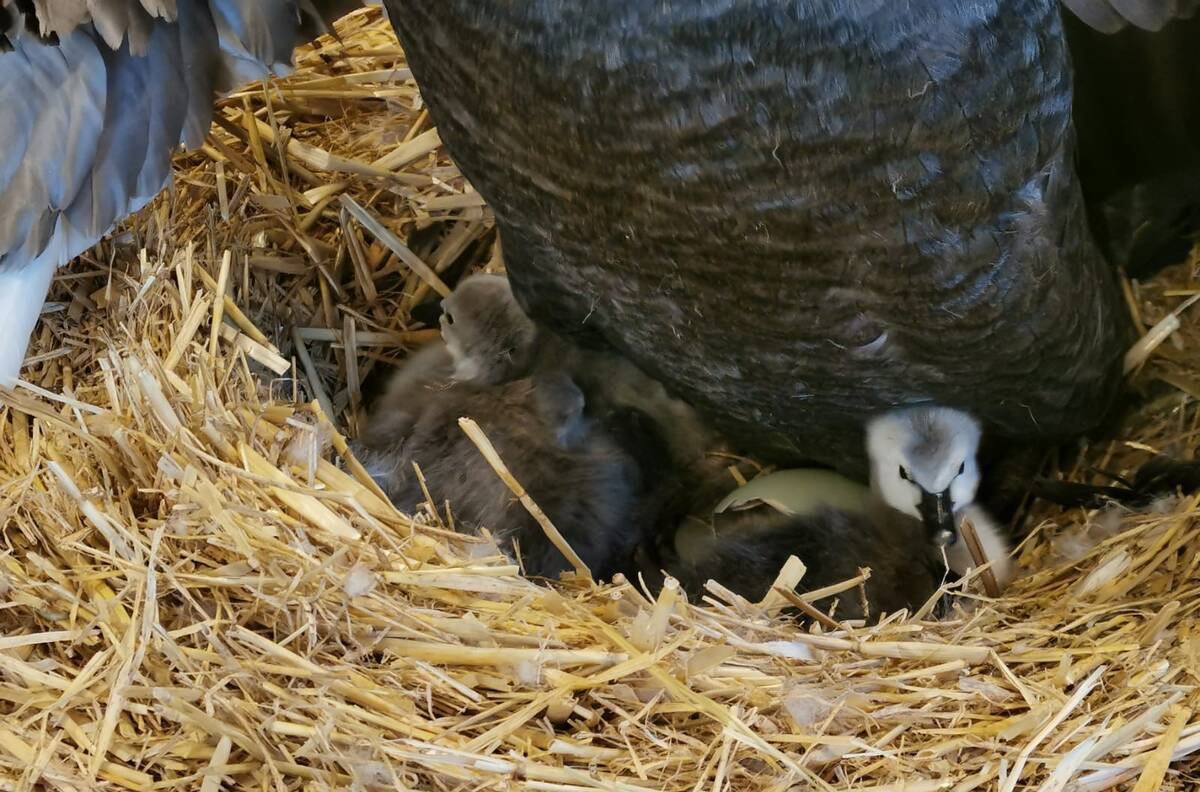
The harmonious image of these faithful swans continues in their parenting. While nest-building is usually the female’s responsibility, the male gets involved at the latest during incubation and raising the young. Although the gray-brown cygnets can swim very soon after hatching, they nevertheless remain in the nest for 2 to 3 weeks—better safe than sorry. Once comfort has proven itself, they aren’t so quick to give it up later on: If conditions on the water become turbulent, they’d rather be carried on their parents’ cozy, dry backs.
Did you know?
A black-necked swan's neck is longer than its body. It uses its neck to forage for aquatic plants at a depth of one meter.
| Order | Geese |
| Family | Ducks |
| Distribution | Australia, Tasmania; naturalized in New Zealand |
| Habitat |    |
| Food |  |
| Activity |   |
| Weight | 3.7–8.7 kg |
| Size | Body length 110–140 cm, wingspan 160–200 cm |
| Service life | 40 years |
| Reproduction | The male begins building the nest. Both parents incubate the clutch of 5–6 eggs for 35–48 days and raise the young together; the young remain with their parents for about a year. |
| Risk |  |
| Enemies | Birds and Rats (for eggs and young) |
Swan Diary
Have you heard? The black-necked swans at the Tierwelt Herberstein have had chicks . Follow the parents’ daily lives in the swan diary and get to know the little black-necked swan chicks!
To the Swan Diary

Tierwelt Herberstein
Steirischer Landestiergarten GmbH
A 8223 Stubenberg am See
Buchberg 50
Phone: +43 3176 80777
Fax: +43 3176 80777 20
Email: info (at) tierwelt-herberstein. at