






Kookaburra
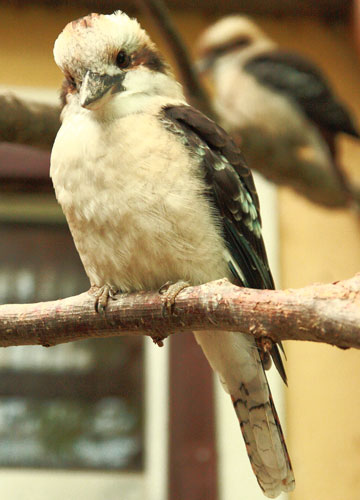
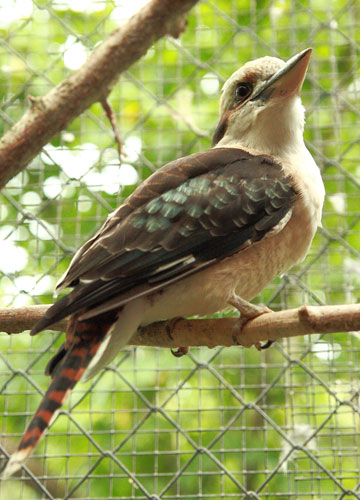
Laughing Kookaburra
Dacelo novaeguineae
What’s so funny here?
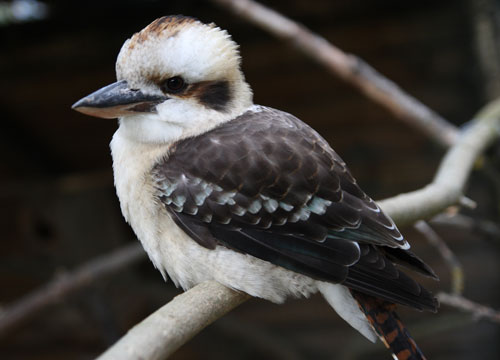
Roaring laughter echoes through the zoo! What’s so funny? Or is someone even being laughed at? No, it’s the Australian kookaburras, also known as “Jägerliest” or “Laughing Hans” in German. Why that is, is probably no longer a secret. They make their voices heard especially in the early morning hours and shortly after sunset, which is why they’re also called the “bushman’s clock.” This is how they communicate with their family members, express great excitement, and stake a claim to their territory. An Australian legend says that the god Bayame commanded the kookaburra to raise its voice at the first sunrise. He was to wake the people so they could witness the beautiful natural spectacle of the sunrise.
These kingfisher relatives feed mainly on insects, but also on small vertebrates and birds. Since they even prey on poisonous snakes, they are quite popular among the local population. They use abandoned tree hollows or empty termite mounds as nesting sites.
Did you know?
Young kookaburras are often what are known as “nest helpers.” They stay with their parents for up to four years and help raise their younger siblings.
| Order | Racketbirds |
| Family | Kingfishers |
| Distribution | Australia, Tasmania, New Guinea |
| Habitat |   |
| Food |  |
| Activity |  |
| Weight | 360 g |
| Size | 40–46 cm |
| Service life | 20 years |
| Reproduction | Incubation period: 25 days, 2–4 eggs |
| Risk |  |
| Enemies | Waran, human |

Tierwelt Herberstein
Steirischer Landestiergarten GmbH
A 8223 Stubenberg am See
Buchberg 50
Phone: +43 3176 80777
Fax: +43 3176 80777 20
Email: info (at) tierwelt-herberstein. at