







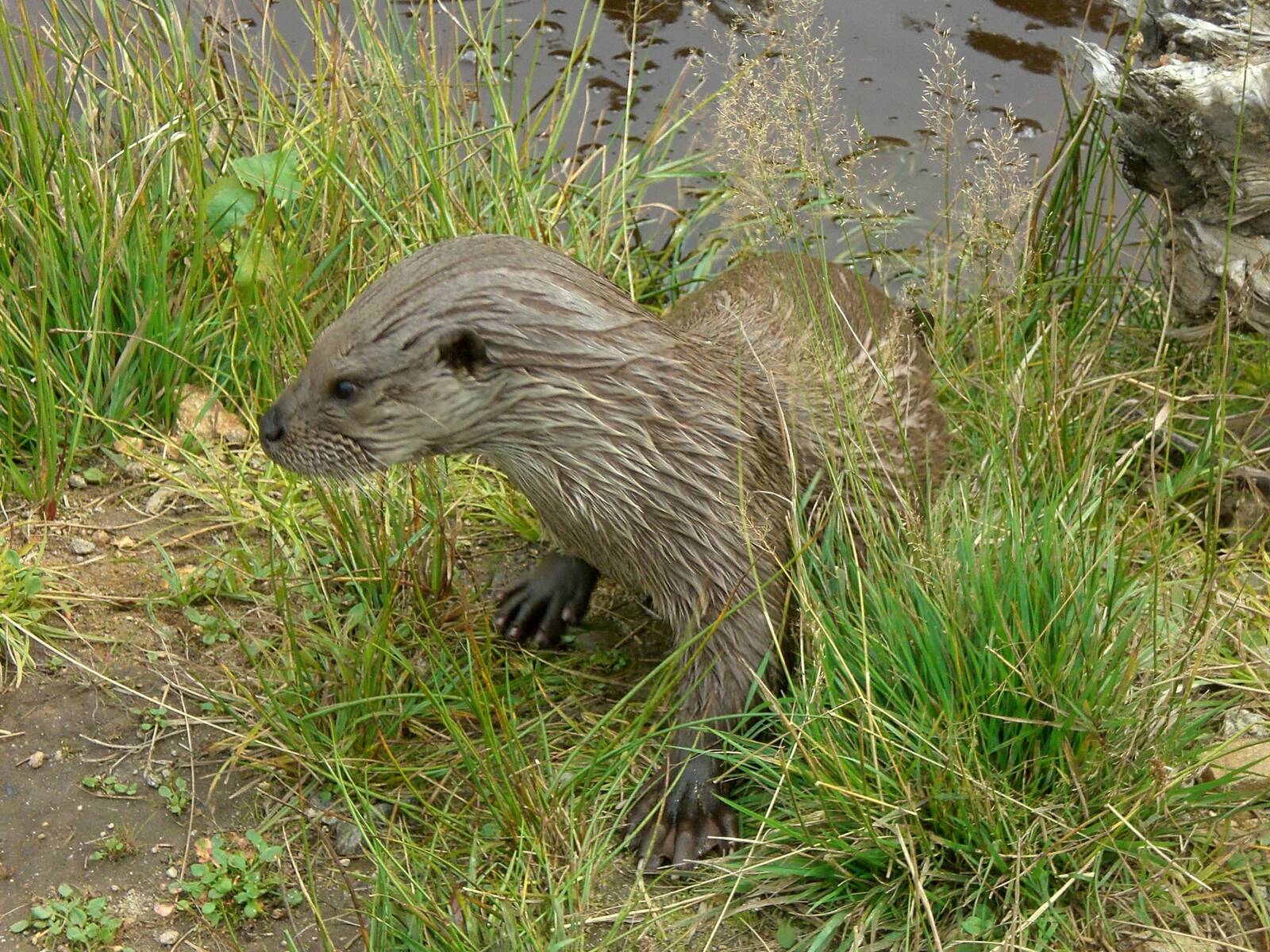
otter
Lutra lutra
A Life in the Water
As an adaptation to life in the water, otters have a streamlined body, webbed feet, closable ears and nostrils, and an extremely dense coat. They have about 50,000 hairs per cm². By comparison, humans have about 120 hairs per cm² on their heads.
Did you know?
The otter has a high metabolic rate. It eats 400 to 1,200 grams of fish every day. That is roughly 10 percent of its body weight.


| Order | Predators |
| Family | Marten |
| Distribution | across large parts of Asia and Europe |
| Habitat |   |
| Food | Fish, amphibians, waterfowl, crustaceans, small mammals, insects |
| Activity |  |
| Weight | 4–12 kg |
| Size | 60–90 cm plus 25–40 cm tail length |
| Service life | up to 13 years old |
| Reproduction | Males reach sexual maturity at 2 years of age, females at 3 years; the mating season is between February and March. After a 2-month gestation period, 1–3 young are born. The young weigh less than 100 grams at birth and are nursed for 2–4 months. They learn hunting techniques from their mother. They do not leave her until they are about 14 months old. |
| Risk |  |
| Enemies | stray dogs, wolves, lynx, ospreys |

Tierwelt Herberstein
Steirischer Landestiergarten GmbH
A 8223 Stubenberg am See
Buchberg 50
Phone: +43 3176 80777
Fax: +43 3176 80777 20
Email: info (at) tierwelt-herberstein. at