







Lowland Tapir in the Tierwelt Herberstein
Lowland Tapir
Tapirus terrestris
Living Fossils with Unexpected Relationships
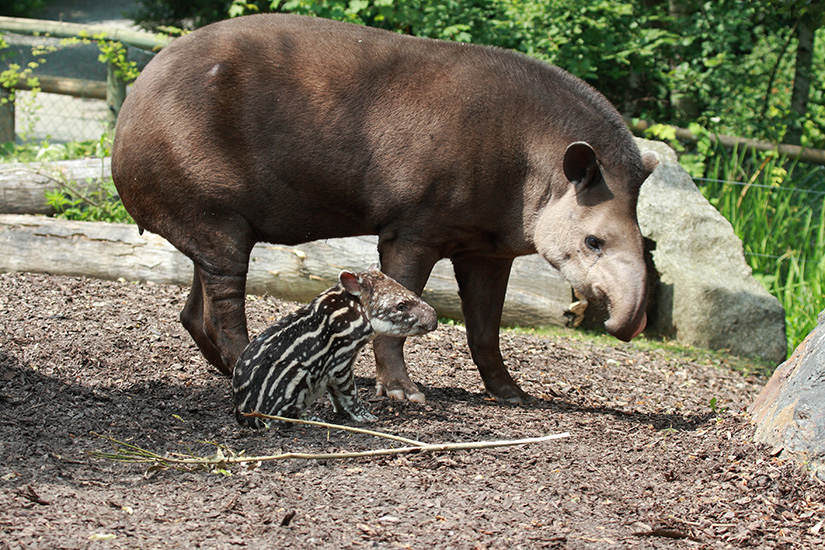
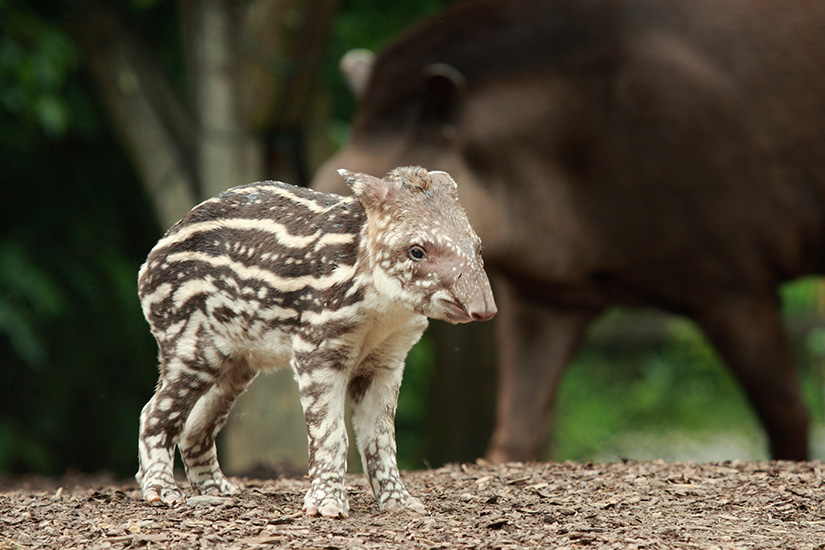
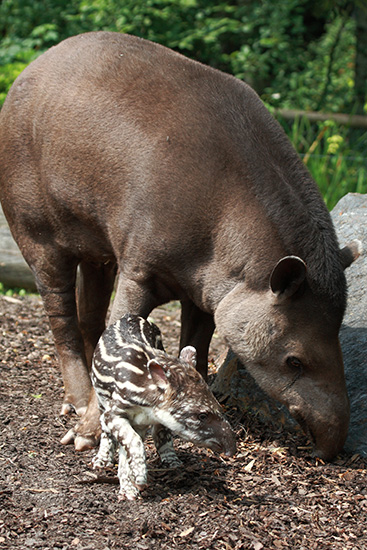
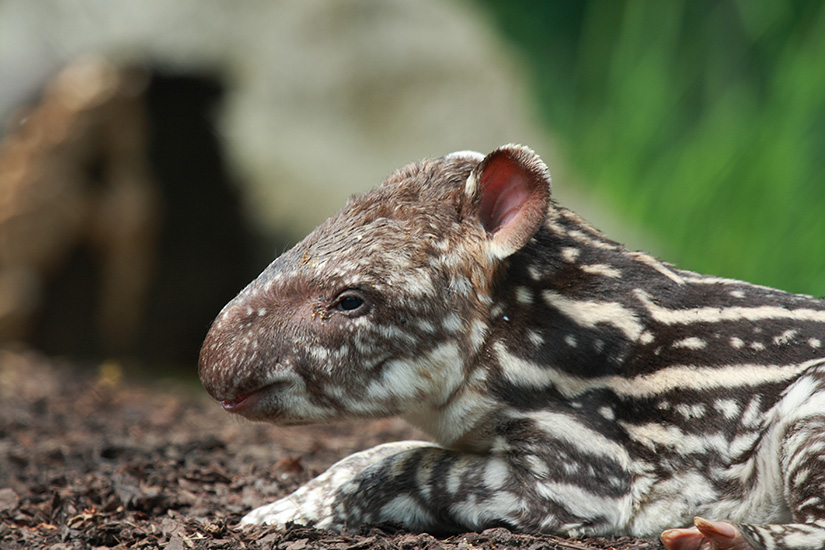
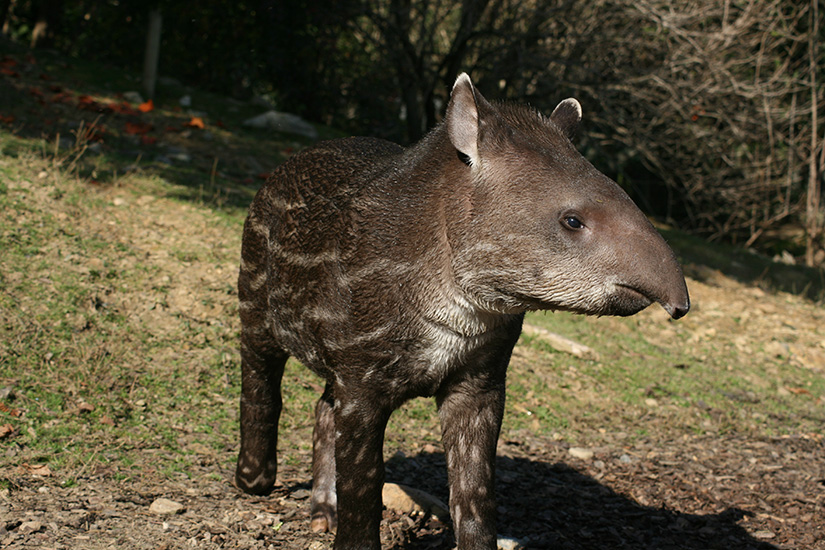
Even though the lowland tapir’s young are striped like a wild boar piglet, they are still not pigs. Rather, this primitive creature, which has not changed significantly since the last Ice Age, is related to rhinos and horses.
Admittedly—one wouldn’t have guessed that so easily. In fact, however, like these two well-known animal species, they belong to the odd-toed ungulates, which are characterized by varying numbers of hooves (except for two, since those are the even-toed ungulates). The tapir has several hooves on each foot: four in front and three in back. Like rhinos, they also suffer from severe nearsightedness, though this bothers them less in the dark.
As nocturnal animals, they prefer to rely on their keen hearing and well-developed sense of smell. But this trunk-like organ—formed by the fusion of the upper lip and nose—is not just for smelling. It is a true multifunctional tool that, in addition to smelling, also serves as a means of touching and grasping. Even the most delicate shoots can thus be plucked from among the sharpest thorns with the help of their long tongue.
The young ones’ striped pattern, which gradually fades, serves as camouflage. When the young one lies in the bushes while its mother goes in search of food, it is thus better camouflaged by the interplay of light and shadow in the forest.
A lively, cheerful community
Lowland tapirs prefer to live in the humid regions of the Amazon rainforest. Their greatest enemy (besides humans) is the jaguar. To avoid leaving telltale scent trails, they therefore defecate in the water.
In fact, they are true water lovers who, as excellent swimmers and divers, spend a lot of time in the cool water.
Did you know?
Watch out if you stand too close to the fence! Our male tapirs usually demonstrate exceptionally good aim when they urinate straight back to mark their territory. However, the stream of urine—which can reach up to 4 meters—can sometimes miss its mark.
| Order | odd-toed ungulates |
| Family | Tapirs |
| Distribution | North and Central South America: From Venezuela to northern Argentina and southern Brazil |
| Habitat |    |
| Food |  |
| Activity |  |
| Weight | 150 to 250 kg |
| Size | Body length (M) 205 cm, body length (W) 220 cm, shoulder height 75–110 cm |
| Service life | 30 years (zoo: 35 years) |
| Reproduction | The mating season is not tied to any particular time of year. After a gestation period of 13 months, a light-striped young—rarely two—is born, which the mother nurses for about 10 months. |
| Risk |  |
| Enemies | Jaguar, Puma, Crocodile, Human |

Tierwelt Herberstein
Steirischer Landestiergarten GmbH
A 8223 Stubenberg am See
Buchberg 50
Phone: +43 3176 80777
Fax: +43 3176 80777 20
Email: info (at) tierwelt-herberstein. at