







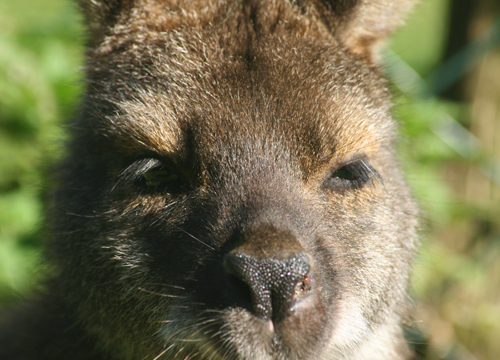
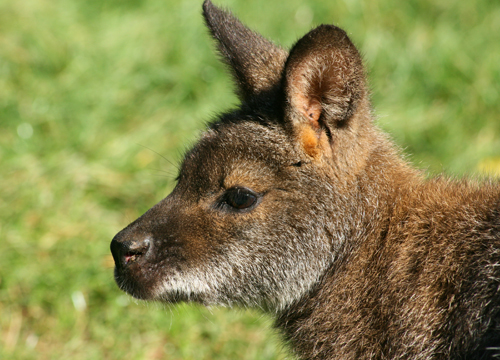
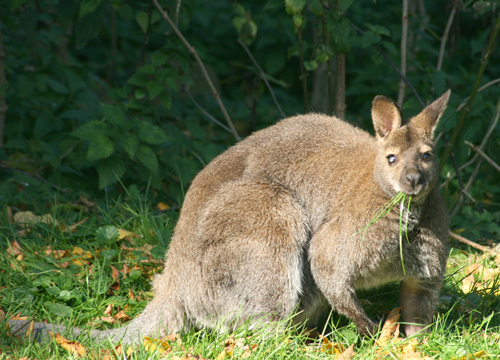
Bennett's Kangaroo
Bennet's Wallaby
Macropus rufogriseus fruticus
A pouch as a nursery
Kangaroos are numerous, with approximately 70 different species, and range in body length from 28 cm (musk rat-kangaroo) to 165 cm (red giant kangaroo). Our Bennett’s wallabies are among the medium-sized hoppers. When the baby of these Australian marsupials is born after a gestation period of just 30 days, however, it weighs only 0.6 g and is about the size of a coffee bean. Still hairless and blind, with the appearance of an embryo, it is nevertheless able to find its way into the pouch on its own. Using swimming-like movements, it makes its way through the fur, which the mother keeps moist by licking. This protects the baby from drying out.
Once inside the pouch, it immediately latches onto a teat, which swells instantly and fills its entire mouth. It remains firmly attached for one to two months, until its jaws are flexible enough for it to let go. Over the next few months, the joey begins to venture out, but always returns to the pouch. At 9 months, it is finally banished from the pouch for good, since by then a younger sibling is usually already inside. As a so-called “walking joey,” however, it still sticks its head into the pouch for a few more months to drink.
Hopping saves energy
Hopping is an extremely efficient mode of locomotion. Like a spring, the energy stored in the tendons upon landing is released. Very little additional energy is required. The powerful leg muscles and long lower legs provide additional support. When moving quickly (Bennett’s kangaroos can hop at speeds over 30 km/h), the tail is mainly used to maintain balance. However, when the kangaroo hops slowly, it does so using the “five-legged gait.” In this gait, the tail acts as a fifth foot to support the front legs while the hind legs swing forward.
Did you know?
On hot days, kangaroos lick their forearms. As the saliva evaporates, it cools the blood in the vessels beneath the skin, thereby cooling the entire body.
| Order | Kangaroo relatives |
| Family | Kangaroos |
| Distribution | Eastern and Southern Australia, Tasmania |
| Habitat |    |
| Food |  |
| Activity |  |
| Weight | 14–19 kg |
| Size | Body length 90–100 cm, tail length 70–75 cm |
| Service life | 15 years |
| Reproduction | Dominant males defend a territory and claim exclusive rights to the females within it. After a gestation period of 30–40 days, the female gives birth to a joey that weighs less than 1 gram. The young climbs into the pouch on its own, latches onto a teat, and spends the next 9 months—until it reaches full maturity—exclusively in its mother’s pouch. |
| Risk |  |
| Enemies | Dingo, Human |

Tierwelt Herberstein
Steirischer Landestiergarten GmbH
A 8223 Stubenberg am See
Buchberg 50
Phone: +43 3176 80777
Fax: +43 3176 80777 20
Email: info (at) tierwelt-herberstein. at