




Animal Sponsorships
I love ANIMALS!
Do you fully agree with this statement? Then show your compassion and sign up for a private sponsorship of an animal at Herberstein. Are you a business owner looking to make a sustainable contribution to society? By investing in a business sponsorship, you can be sure that your financial contribution stays in the region. When you become a sponsor, you’ll form a special bond with an animal that will bring you great joy. We offer a variety of packages. Gift certificates are available in our online shop.
With your sponsorship, you help ensure the upkeep and care of your sponsored animal, support us with the cost of food, and make a direct contribution to species conservation. The Styrian State Zoo actively participates in a total of 22 national and international breeding programs to protect endangered species from extinction.
The following prime examples illustrate just how important it is to engage in active species conservation.
Information and advice: Tel. +43 3176 80777 or info (at) tierwelt-herberstein. at
Are you thinking about becoming a sponsor? Then check out our Social Wall and let our animal residents win you over. Already a sponsor? Share a post about your sponsored animal on Facebook, Instagram, Twitter, or YouTube with the hashtag #herberstein, and we’ll share it on our website!
Bison
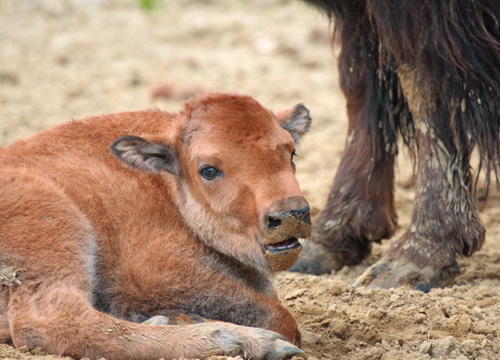
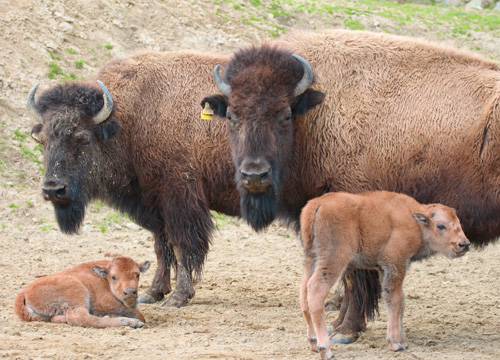
In the 17th century, approximately 60 million bison roamedthe prairies of North America. These seemingly peaceful powerhouses were the lifeblood of the Plains Indians. The bison’s hides and skins were used to make tents and clothing, their bones served as tools and cutlery, and their meat was used for food. To subjugate the nomadic Plains Indians, white settlers began systematically exterminating the bison starting in 1830. By the end of the 19th century—in 1889, to be precise—only 835 bison remained. The animals were placed under protection in the early 20th century, and the first bison enclosures were established. Today, approximately 40,000 bison live in protected areas in Canada and in Yellowstone National Park in the United States.
Currently, the Herberstein herd consists of the young bull Texas, the three cows Alberta, Minnesota, and Nessie, three young females, and the young bison bull Gusti.
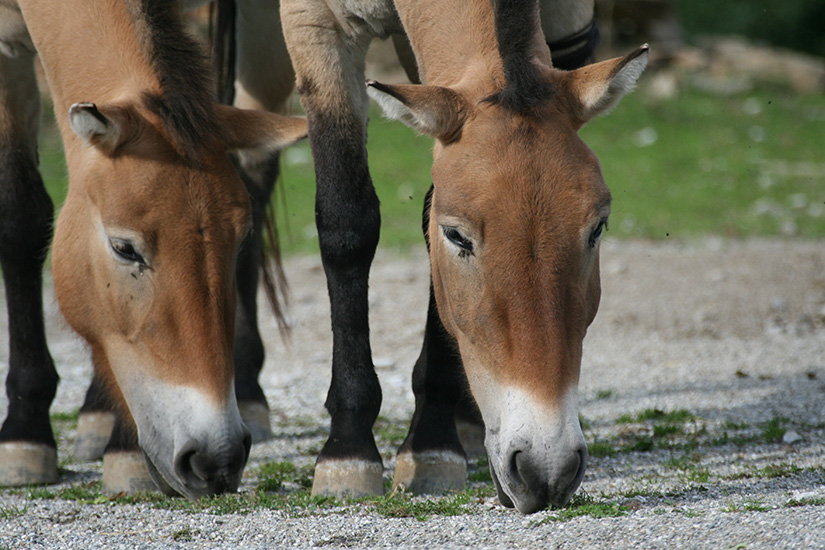
Przewalski's horses
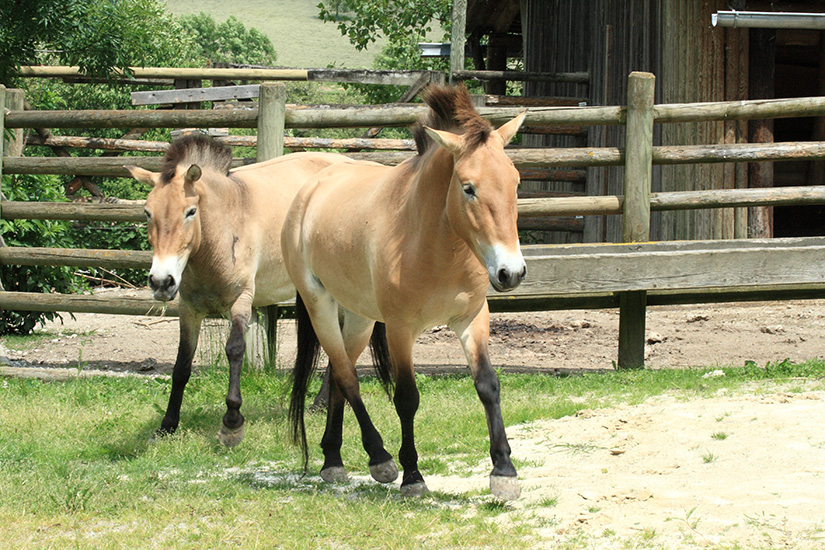
These horses with the complicated name—which traces back to the Russian explorer Nikolai Mikhailovich Przewalski—have also had a difficult history. The Przewalski’s horse is a species of Asian wild horse and was originally found in Mongolia. Beginning with World War II, its population declined drastically—partly due to displacement by herds of domestic livestock and partly because they were hunted for meat by Kazakh tribes. According to records, by the late 1960s, not a single wild horse remained in the wild. At the beginning of the 20th century, private owners brought a few horses to European zoos —laying the foundation for the successful conservation of the species. Through coordinated breeding programs, a stable zoo population was established despite the small number of animals. In 1992, the first horses were finally reintroduced to Mongolia. Today, there are once again wild herds, though they remain critically endangered.
Four mares have found a home at Herberstein Wildlife Park: Manou, Sorella, Ronja, and Quintessa. The latter two moved to Styria from the Grünau Wildlife Park in Upper Austria as recently as the fall of 2018.
Tierwelt Herberstein
Steirischer Landestiergarten GmbH
A 8223 Stubenberg am See
Buchberg 50
Phone: +43 3176 80777
Fax: +43 3176 80777 20
Email: info (at) tierwelt-herberstein. at