







Emu
Emu
Dromaius novaehollandiae
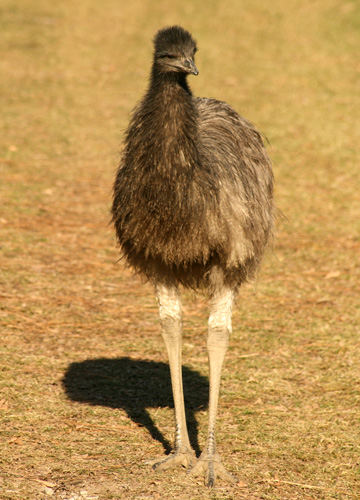
, the Powerful-Voiced Flightless Birds The most impressive characteristic of emus is their vocal ability. In addition to grunting, belching, and growling sounds, they can also produce a resonant drumming sound that can be heard up to 2 km away. These sounds are produced in the throat. There, the trachea connects to the neck air sacs, which act as resonance chambers. The air sacs are otherwise used for breathing, pumping air through the lungs like a bellows.
Did you know?
The second-largest birds on Earth, after the ostrich, have wings that are only 20 cm long.
| Order | Running Birds |
| Family | Emus |
| Distribution | Australia |
| Habitat |  |
| Food |  |
| Activity |  |
| Weight | Men 50 kg, Women 55 kg |
| Size | Height: 175 cm |
| Service life | 5–10 years (zoo: 16 years) |
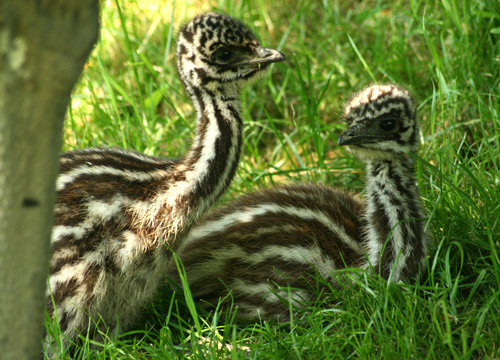
| Reproduction | The breeding season runs from December through April. Mating is initiated by the females. The hens lay up to 25 eggs in a shallow depression in the ground, which the rooster incubates for about 56 days. The young birds reach sexual maturity after 2–3 years. |
| Risk |  |
| Enemies | Human |

Tierwelt Herberstein
Steirischer Landestiergarten GmbH
A 8223 Stubenberg am See
Buchberg 50
Phone: +43 3176 80777
Fax: +43 3176 80777 20
Email: info (at) tierwelt-herberstein. at