




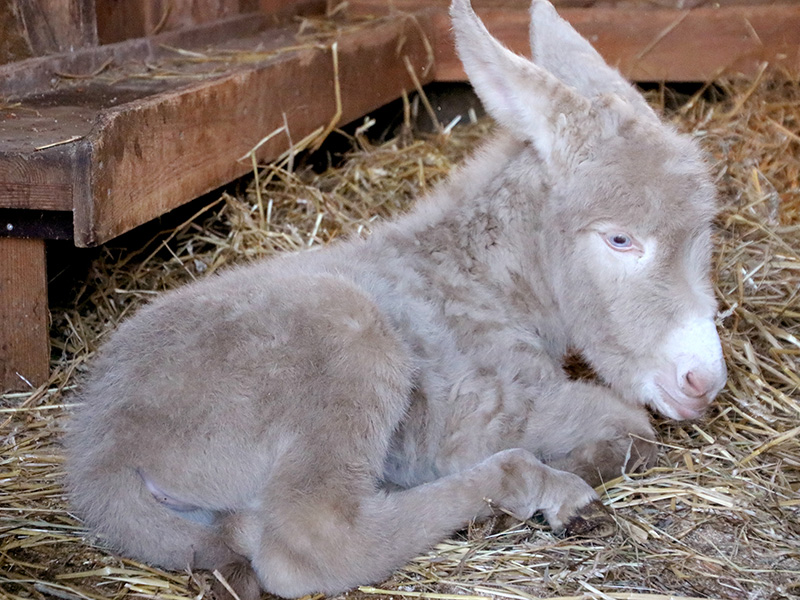
Bright blue eyes, light yellow fur, and weighing about 18 kg—these are the key details of the zoo’s newest baby, who goes by the name Athos. At the same time, this young animal is making history, as it is the first donkey foal in the history of the Styrian State Zoo.
During the Austro-Hungarian Empire, the animal was bred as a hobby and kept as a pet by the wealthy. In 1982, this species was rediscovered in Herberstein.
Unfortunately, there are currently only about 250 individuals left worldwide. “This breeding success lays another foundation stone for the Herberstein line,” reports FTA Zoological Director Dr. Reinhard Pichler, adding: “In Austria, there is still a larger population in the Neusiedler See/Seewinkel National Park—the Neusiedler See line. It also cannot be ruled out that there are ‘unidentified’ animals in private herds, particularly in Hungary.”
Historically, the naming of the breed has also taken on a life of its own. Known as the “albino donkey” during the monarchy, the breed has been referred to as the “White Baroque Donkey” for about 5 years. According to recent research, the Champagne gene has been discovered in animals of the Herberstein line. With a touch of humor, the Styrian line can also be called the “Champagne Donkey.”