







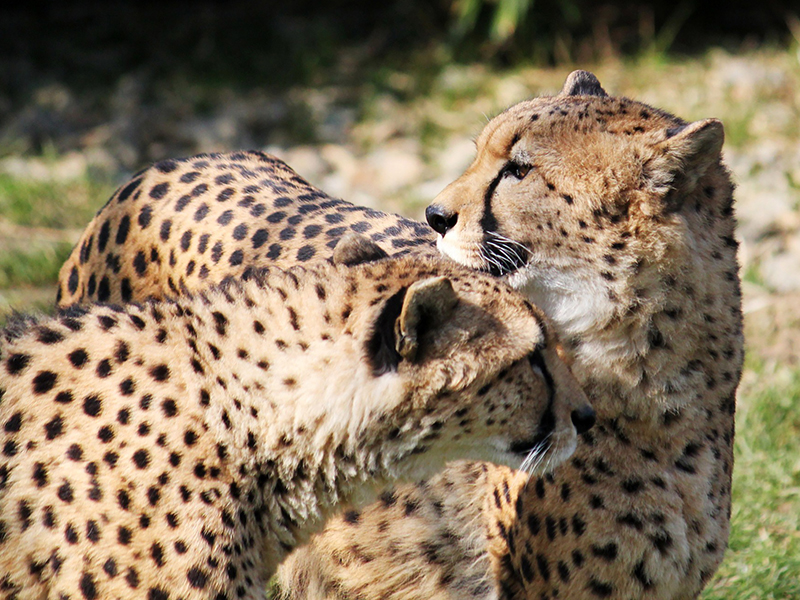
The 5-year-old cheetah siblings Kito and Kubango—like all the animals at Herberstein—enjoy a species-appropriate habitat that replicates a section of their natural environment in the wild. They won’t have to give up either their running training or their hunting habits: they hunt their “meals” on one of the longest zoo hunting trails in Europe!
First Prey Simulator for Cheetahs in Herberstein
Under the expert guidance of Prof. Otto König, the first prey simulator—a feeding device for cheetahs—was developed in 1978. Meat is pulled through the enclosure on a tow rope and chased by the cheetahs as prey. This invention is now used by numerous zoos worldwide and is regarded as a pioneering achievement in the field of “behavioral enrichment,” or species-appropriate enrichment.
For zoological director Reinhard Pichler, one thing is certain: “The cheetah feedings are particularly impressive for our visitors. They can observe the swift big cats up close as they hunt, almost as if in the wild—impressive scenes that are otherwise only seen in thrilling wildlife documentaries on television.” Cheetahs can reach speeds of up to 100 km/h over short distances.
In Herberstein, the two new arrivals are also slowly getting to know their fellow cheetah, the 6-year-old Dajan. Anyone who keeps these cats knows how difficult it is to introduce them to one another. They’ll spend their first few days indoors, after which a fence will separate them from Dajan. This will allow the animals to get used to one another from a distance. Hopefully, the three will soon be able to “sniff each other out.”