






Lightning and Hail
Presentation and Group Discussion
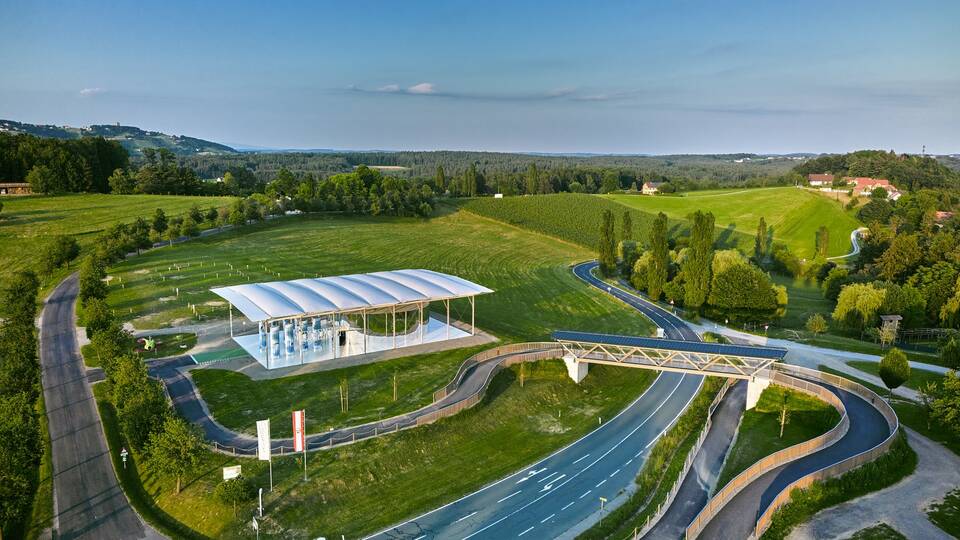
Markus Jeschaunig & the Styrian Hail Protection Cooperative as guests at the Mobile Pavilion
: Lecture, discussion, and formation flyover
Markus Jeschaunig (artist and architect)
Josef Mündler (Styrian Hail Protection Cooperative)
- 09.09.2023
- 2:00 p.m.
- Mobile Pavilion
- Alternative date in case of weather unsuitable for flying: September 16, 2023, 2:00 p.m.
In recent years, global climate change has been intensifying extreme weather events. This includes the increased risk of hail and severe storms in Styria and the resulting collateral damage.
Artist and architect Markus Jeschaunig will shed light on the genesis of his art installation “Electric Atmospheres,” which explores lightning, before Josef Mündler, chairman of the Styrian Hail Protection Cooperative, provides fascinating insights into the history, present, and future of hail control in Styria.
Markus Jeschaunig’s initial project was to make the atmosphere tangible as a planetary hyperobject, which then led to an exploration of lightning. Lightning has both destructive and life-giving effects. The video is based on an artistic experimental setup designed to produce physical traces of lightning strikes.
The Styrian Hail Defense Cooperative was founded in 1955 to prevent crop failures and damage to buildings and industrial facilities. While in the early years hail rockets were fired from the ground into the lower cloud layers, in 1973 the Styrian Hail Defense Cooperative switched to using aircraft equipped with so-called hail generators to combat hail, which could introduce silver iodide condensation nuclei directly into the updrafts of the lower cloud layers to prevent the formation of large hailstones. In 2001, in collaboration with engineers, a globally innovative hail burner was designed; combined with a digitized control system for the combustion process, this enabled the Styrian Hail Defense Cooperative to become even more efficient. Today, the fifth generation of this groundbreaking in-house development is already in operation. The Styrian Hail Defense Cooperative has been working for years with researchers from a wide variety of universities and research institutions on basic scientific research into hail control and the continuous improvement of aeronautical hail defense.
Today, the ten pilots, flying their four Cessna 182 aircraft, cover an area of 360,000 hectares in hail control operations, logging 330 flight hours per year.
How can one approach the phenomenon of lightning from an artistic perspective? How does hail control work from a technical and logistical standpoint? What challenges do Styrian hail control pilots face today? And what direction will hail control take in the future?

Tierwelt Herberstein
Steirischer Landestiergarten GmbH
A 8223 Stubenberg am See
Buchberg 50
Phone: +43 3176 80777
Fax: +43 3176 80777 20
Email: info (at) tierwelt-herberstein. at